

The Day I Asked AI Why Monokee Was Different
Contents
Identity Fusion Announces Strategic Partnership with Dock Labs to Bridge the Gap Between Legacy IAM and Next-Generation Identity Solutions
New Year, New Beginnings: Embracing the Future of Identity and Access Management in 2025
Your New Digital ID: How Identity Wallets Are Redefining Trust in the Digital Age
There is a running joke in cybersecurity that every Identity and Access Management (IAM) expert uses the same slide deck.
A list of acronyms that sounds suspiciously like someone lost a Scrabble tournament.
MFA. SSO. CIAM. PAM. IGA.
Stir vigorously and present as innovation.
So, as an experiment, I decided to let artificial intelligence weigh in. I chose one of our vendor partners as the subject. What follows are the results of me allowing AI to write this article.
I started by asking AI a simple question:
"What differentiates Monokee from other IAM platforms?"
Then I asked it to identify the functions Monokee executes particularly well.
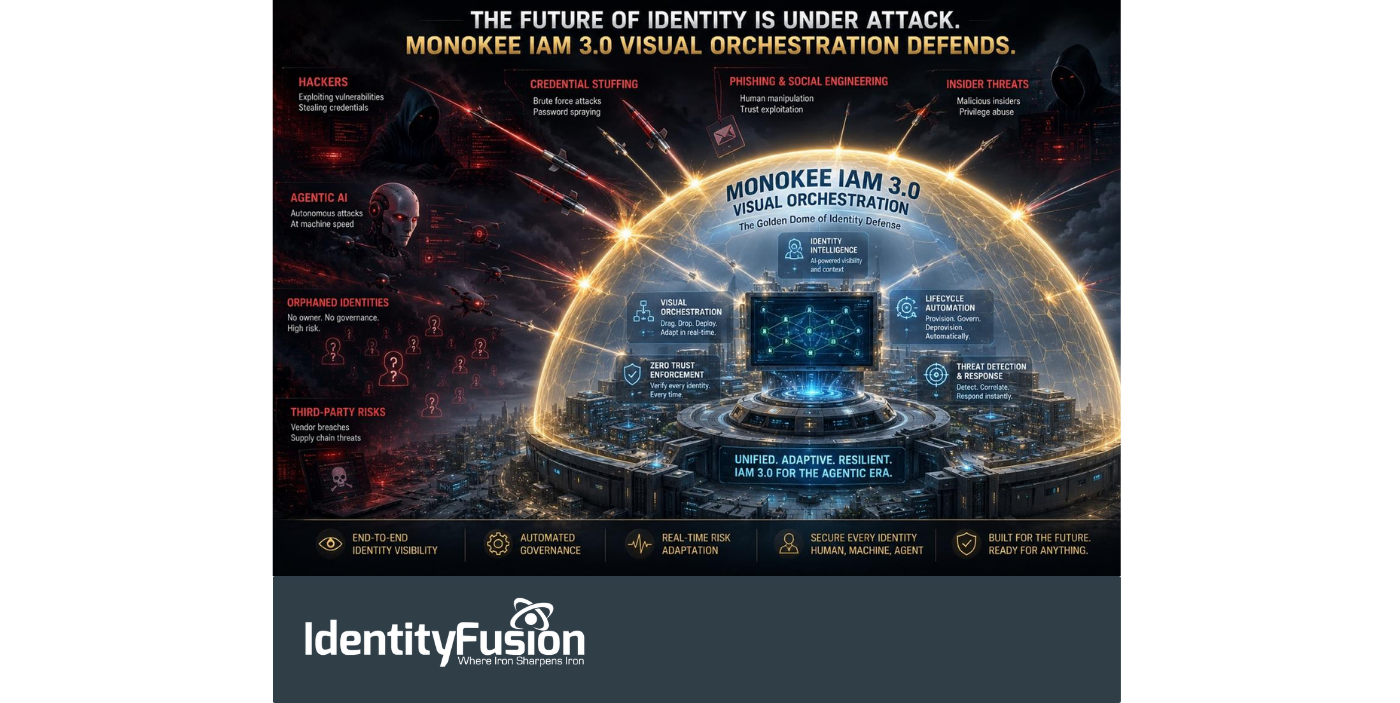
Finally, I asked it to visualize the answer, not as a boring architecture diagram, but as something that would communicate the power of a modern IAM platform operating in an era of AI-driven attacks, autonomous agents, machine identities, insider threats, and constantly evolving risk.
The result was the graphic above.
And while the artwork may be dramatic, the conclusions were surprisingly grounded. Here is the article as written by AI:
Identity Has Changed. Most IAM Platforms Haven't.
The reality is that many IAM solutions were designed for a different world.
A world where:
- Employees sat in offices.
- Applications lived inside data centers.
- Passwords were considered acceptable security.
- Human users represented most identities.
That world no longer exists.
Today organizations must secure:
- Customers
- Employees
- Partners
- APIs
- Service accounts
- Bots
- AI agents
- Machine identities
- Temporary and ephemeral workloads
The identity perimeter has exploded.
At the same time, attackers have become faster, more automated, and increasingly powered by AI.
Credential stuffing attacks occur at machine speed.
Phishing campaigns are personalized by generative AI.
Third-party supply chain attacks bypass traditional controls.
Orphaned identities accumulate silently inside organizations.
Insider threats remain one of the most difficult risks to detect.
The challenge is no longer simply authenticating users.
The challenge is orchestrating trust continuously.
This is where Monokee begins to separate itself.
The AI Verdict: Monokee Excels at Orchestration
One of the strongest themes identified by AI was that Monokee approaches IAM as an orchestration problem rather than a collection of disconnected products.
Traditional IAM often resembles a pile of technologies connected through custom code:
- Identity repository
- Authentication platform
- Governance solution
- Authorization engine
- Workflow system
- Threat monitoring tools
Each component may work well independently.
Getting them to work together is often where projects become expensive, slow, and brittle.
Monokee's architecture focuses on visual orchestration.
The platform allows organizations to design, modify, and deploy identity processes visually rather than relying heavily on custom development.
This may sound simple, but it changes the economics of IAM.
Instead of waiting months for developers to create new workflows, organizations can adapt policies, onboarding processes, risk responses, and governance controls in real time.
In an environment where business requirements change weekly, speed becomes a security advantage.
Zero Trust Without the Marketing Buzzwords
The graphic depicts a defensive dome surrounding the enterprise.
That is more than artistic license.
At its core, Monokee aligns naturally with modern Zero Trust principles.
The platform assumes that no identity should be trusted automatically.
Verification becomes continuous rather than a one-time event.
Every authentication request can be evaluated using context such as:
- User behavior
- Device posture
- Geographic location
- Risk signals
- Access patterns
- Historical activity
Rather than granting permanent trust, Monokee helps organizations establish dynamic trust.
Trust becomes earned repeatedly.
Not inherited forever.
In cybersecurity terms, this dramatically reduces the blast radius of compromised credentials.
Identity Intelligence Becomes a Force Multiplier
Another capability highlighted by the AI analysis was identity intelligence.
Many IAM systems focus primarily on storing identities.
Monokee focuses on understanding them.
Identity intelligence provides visibility into:
- User behavior
- Access patterns
- Privilege accumulation
- Risk indicators
- Identity relationships
- Governance violations
This becomes increasingly important in environments containing thousands—or millions—of identities.
Humans cannot manually analyze this volume of information.
AI-assisted intelligence helps security teams identify:
- Excessive privileges
- Abnormal access requests
- Potential insider threats
- Dormant accounts
- Orphaned identities
- Emerging attack patterns
Think of it as moving from a static phone book to an active security radar system.
Lifecycle Automation: The End of Manual Identity Management
If there is one area where organizations continue to waste staggering amounts of money, it is manual identity administration.
Provisioning.
Deprovisioning.
Role assignments.
Approval workflows.
Access reviews.
Most organizations still perform too much of this work manually.
Monokee automates identity lifecycle management from creation through retirement.
This delivers benefits that extend beyond efficiency.
Automation improves:
- Security
- Compliance
- Audit readiness
- User experience
- Operational costs
More importantly, it reduces human error.
And if history has taught us anything, human error remains one of the most reliable attack vectors ever invented.
Threat Detection and Response at Identity Speed
Traditional security tools often focus on networks, endpoints, or infrastructure.
Monokee places identity at the center of detection and response.
That distinction matters.
Attackers increasingly target identities rather than systems.
Compromising a valid credential is often easier than exploiting software vulnerabilities.
By correlating identity events across the environment, Monokee can help organizations identify suspicious activity faster and respond more effectively.
The result is a shift from:
"Something bad happened."
to
"Something suspicious is happening right now."
That difference can mean the difference between an investigation and a breach headline.
The Rise of Agentic AI Makes Modern IAM Mandatory
One section of the graphic highlights Agentic AI.
This may be the most important element in the entire image.
Organizations are rapidly deploying AI agents capable of:
- Accessing systems
- Retrieving data
- Executing workflows
- Making decisions
- Acting autonomously
These agents require identities.
Permissions.
Governance.
Auditability.
Accountability.
In other words, they create an entirely new category of non-human identities.
Many legacy IAM platforms were never designed for this reality.
Monokee's orchestration model positions it well for environments where humans, machines, APIs, bots, and AI agents all require coordinated identity governance.
The future will contain more machine identities than human identities.
Platforms that fail to recognize this shift will increasingly struggle to remain relevant.
The Golden Dome Analogy
The AI chose to represent Monokee as a "Golden Dome" protecting the enterprise.
While admittedly dramatic, the metaphor is useful.
Traditional IAM often resembles a castle wall.
Strong.
Static.
Difficult to modify.
Monokee resembles a dynamic defense system.
Adaptive.
Intelligent.
Continuously responding to changing threats.
The difference is similar to comparing a medieval fortress to a modern integrated air defense network.
One waits for attacks.
The other actively adapts to them.
Final Thoughts
After reviewing the AI-generated analysis and the resulting visualization, a clear theme emerged.
Monokee is not attempting to be just another IAM platform.
Its differentiation lies in combining:
- Visual orchestration
- Identity intelligence
- Lifecycle automation
- Zero Trust enforcement
- Threat detection and response
- Governance automation
- Support for human and non-human identities
into a unified operational model.
In a market crowded with products that often require armies of consultants and years of customization, the ability to visually adapt identity processes may prove to be one of the most valuable capabilities of all.
The irony is that I originally asked AI to explain why Monokee was different.
Instead, AI may have highlighted a larger truth.
The future of identity is no longer about managing users.
It is about orchestrating trust across humans, machines, applications, APIs, and autonomous agents operating at machine speed.
And that future is arriving much faster than most organizations realize.
AI provided the analysis. Now let's have the conversation. Meet with our team at Identiverse 2026 to discuss the future of identity, trust, and security—and what it means for your organization.
Book your 1:1 with us today:
Identity Fusion Announces Strategic Partnership with Dock Labs to Bridge the Gap Between Legacy IAM and Next-Generation Identity Solutions
New Year, New Beginnings: Embracing the Future of Identity and Access Management in 2025
Your New Digital ID: How Identity Wallets Are Redefining Trust in the Digital Age