

IAM Orchestration for Multi-Cloud IAM
Contents
For years, organizations were told that moving to the cloud would simplify infrastructure. Then reality arrived.
It is true most enterprises today are not running a single cloud. They are operating across AWS, Azure, Google Cloud, private cloud environments, SaaS platforms, and increasingly AI services. Add regulatory requirements, regional data residency mandates, acquisitions, and legacy applications, and the result is a sprawling identity ecosystem where access decisions occur across dozens of disconnected systems.
Given some of the massive failures of cloud providers many clients are trying to deploy duplicate implementations in disparate cloud systems. The obvious challenge is orchestrating multi-cloud identity across an ever-changing digital battlefield.
Some vendors will claim they can do multi-cloud while the truth is a little short of the goal.
The Multi-Cloud Identity Problem
Every Identity cloud provider approaches IAM differently.
AWS relies heavily on policies, roles, and temporary credentials. Azure introduces its own role structures and entitlement models. Google Cloud adds another authorization framework. SaaS applications bring their own identity stores, APIs, and access models. The result is a patchwork of identity controls that security teams must somehow manage consistently.
The most common challenges include:
• Inconsistent access policies across clouds
• Multiple identity stores
• Credential sprawl
• Fragmented audit trails
• Different authorization models
• Increased attack surface
• Compliance complexity
• Non-human identity proliferation
• AI agents operating with excessive permissions
Many organizations believe they have implemented a multi-cloud strategy when what they actually have is multiple disconnected IAM systems operating independently.
That distinction matters.
When an employee changes roles, leaves the company, or gains elevated privileges, the change must propagate everywhere. In traditional architectures, synchronization delays, policy inconsistencies, and manual processes create security gaps. These gaps are precisely where attackers thrive.
The Vendor Myth of "Like-for-Like" Multi-Cloud Deployments
One of the industry's least discussed realities is that most cloud and on-premises IAM offerings are not functionally equivalent. This is most common with vendors whose platform is based on decades old technology.
Vendors often market their cloud and on-premises solutions as though they provide identical capabilities. Organizations frequently discover during implementation that features available in one environment do not exist in another, or work differently enough to require custom integrations and operational workarounds. The result is increased implementation cost, additional staffing requirements, and inconsistent operational processes.
Security teams end up supporting multiple versions of what was supposed to be a single platform.
This creates operational debt that grows every year.
The Rise of Non-Human Identities and AI Agents
Human users are no longer the dominant identity type.
Service accounts, APIs, workloads, containers, bots, machine identities, and AI agents now outnumber human identities in many organizations. These identities move between clouds, invoke services, access data, and make autonomous decisions. Traditional IAM architectures were never designed for this scale or velocity.
Recent industry research highlights a troubling trend: organizations struggle to distinguish human actions from AI agent activity, while many AI agents operate with excessive permissions and unclear ownership.
The old model of provisioning access and reviewing it quarterly simply cannot keep pace.
Identity must become dynamic.
Identity must become contextual.
Identity must become orchestrated.
Why IAM 2.0 Struggles in Multi-Cloud Environments
IAM 2.0 was designed around static systems.
The assumptions were simple:
· Users log in.
· Access is granted.
· Permissions remain relatively stable.
· Reviews happen periodically.
Multi-cloud environments shattered those assumptions.
Applications are ephemeral.
Containers appear and disappear in seconds.
Workloads migrate between providers.
AI agents invoke APIs dynamically.
Business requirements change continuously.
Static identity systems struggle because they were designed to answer a single question:
"Who are you?"
Modern security requires answering a far more important question:
"What should you be allowed to do right now under these specific conditions?"
Enter The IAM 3.0 Identity Orchestration Era
IAM 3.0 changes the architectural model entirely.
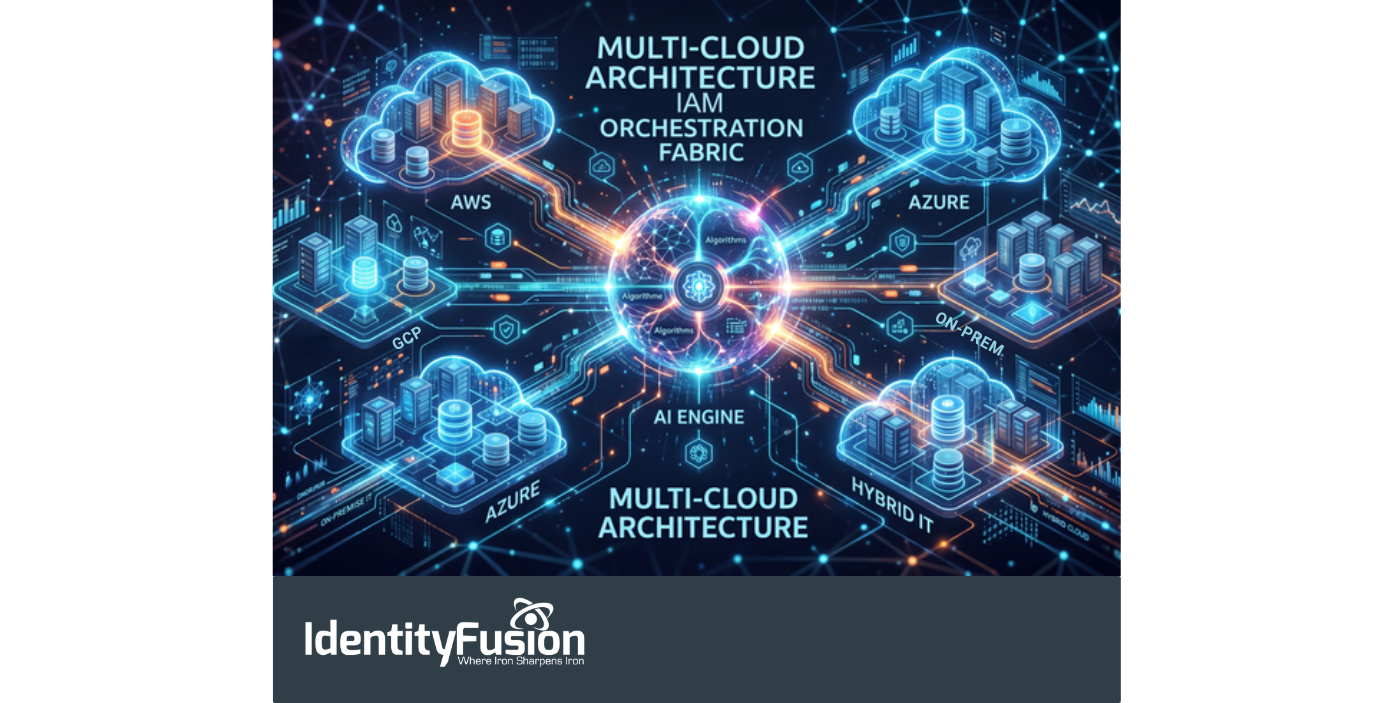
Rather than treating identity as a collection of disconnected products, IAM 3.0 treats identity as a dynamic control plane operating across the entire enterprise.
The focus shifts from identity storage to identity orchestration.
Instead of hard-coding business logic into individual platforms, IAM 3.0 orchestration creates a decision layer capable of coordinating:
· Authentication
· Authorization
· Identity governance
· Risk analysis
· Threat detection
· AI agent governance
· Compliance controls
· Multi-cloud policy enforcement in real time.
Advanced IAM 3.0 Orchestration Solves the Multi-Cloud Challenge
The most successful multi-cloud strategies increasingly separate the control plane from the execution plane. Cloud resources continue operating where they provide the greatest business value, while orchestration governs how identity decisions are made across the environment.
This approach provides several advantages.
Unified Policy Enforcement
Policies are defined once and orchestrated everywhere.
Instead of maintaining different authorization models for AWS, Azure, GCP, and SaaS applications, orchestration translates business intent into provider-specific controls.
Real-Time Risk Response
IAM 3.0 orchestration can detect risk signals and immediately modify access decisions without system downtime.
A compromised credential can trigger automated policy changes across every cloud environment simultaneously.
Reduced Operational Complexity
Security teams no longer need to become experts in every cloud provider's IAM implementation. The orchestration layer abstracts complexity and provides a consistent operational model.
AI and Machine Identity Governance
As AI agents become more prevalent, orchestration provides centralized visibility and control over non-human identities.
Instead of relying on static service accounts, organizations can implement contextual, temporary, purpose-driven access models.
Faster Adaptation
Attack surfaces change daily.
Traditional IAM projects often require days if not months of development to implement policy changes. Modern IAM 3.0 orchestration platforms enable low-code and no-code modifications that can be deployed rapidly without extensive custom development.
Best Practices for Multi-Cloud IAM Success
Organizations pursuing multi-cloud IAM modernization should focus on several principles:
· Federate identity whenever possible.
· Implement least-privilege access consistently.
· Use temporary credentials instead of long-lived secrets.
· Automate lifecycle management.
· Continuously monitor identity activity.
· Govern machine identities as rigorously as human identities.
· Centralize visibility while decentralizing execution.
· Build Identity Fabric around IAM 3.0 orchestration rather than point-product orchestration or integration.
The Future Is Not More IAM Tools
The future of multi-cloud security will not be won by deploying more identity products. It will be won by creating a unified orchestration layer capable of dynamic instead of static deployments, governing all identities, orchestrating workloads, controlling AI agents, updating application connections, and securing data across increasingly complex environments.
The organizations that succeed will not be the ones with the largest collection of IAM tools. They will be the organizations that transform identity into a dynamic control plane capable of responding to threats, business demands, and technological change in real time. And as multi-cloud environments become increasingly interconnected, orchestration is the critical capability that separates organizations struggling with complexity from those successfully harnessing it.
Meet with me at Identiverse to explore your multi-cloud needs.