

IAM 2.0 is a Game of Stratego®
Contents
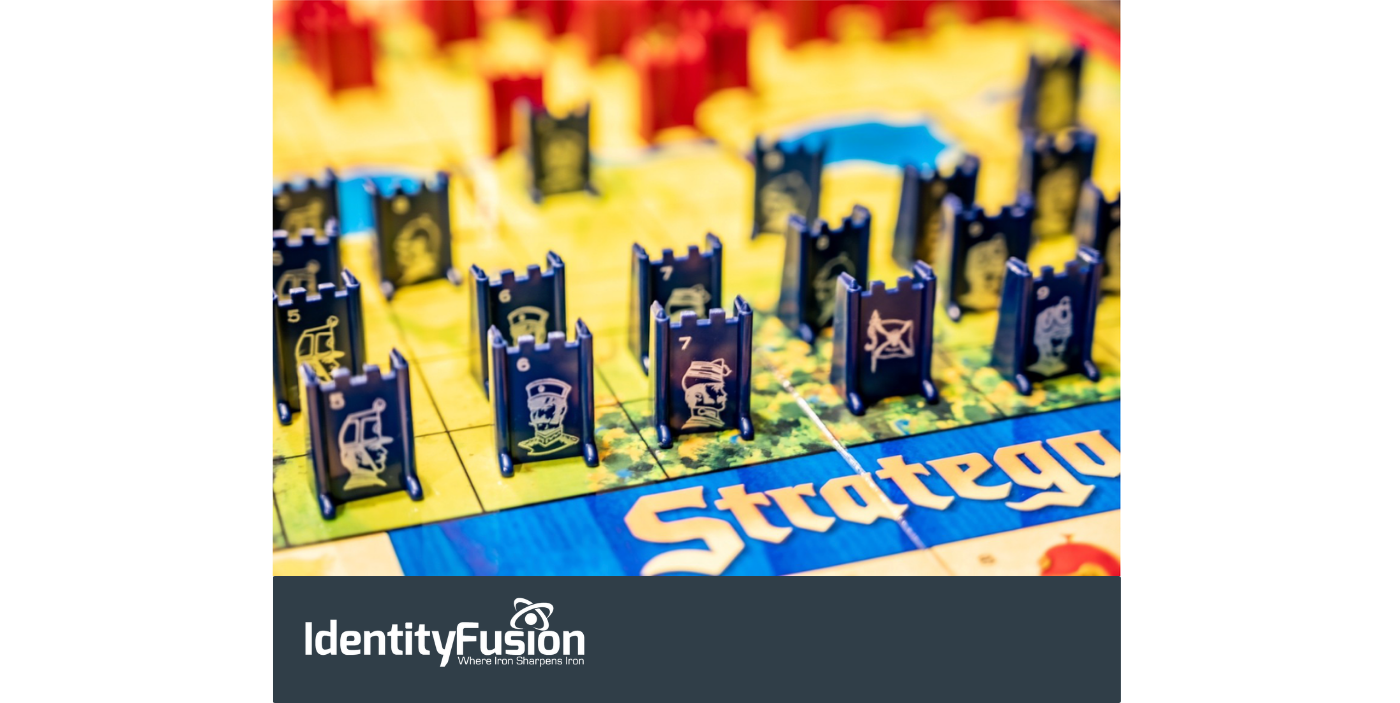
There was a time when security looked a lot like the game, Stratego®.
A flat board. Fixed pieces. Hidden ranks. Predictable movement.
You built your defenses carefully behind established lines. You protected the flag. You trusted the perimeter. The rules were known, the battlefield was visible, and the identities moving across the board were almost entirely human. A firewall was a wall. A VPN was a guarded bridge. Identity and Access Management was little more than the soldier standing at the gate with a clipboard and a flashlight asking, “Who goes there?”
And for a time, that was enough.
The systems were slower. The networks were smaller. The identities were finite. The threats generally approached from the outside, loud and obvious, like an army marching toward the castle walls. Security was built around containment. Control. Structure. Rank.
Flat board thinking.
But here’s the uncomfortable truth buried inside the old game of Stratego®: once the pieces are placed, they do not evolve. They do not adapt. Their rank never changes. Their behavior remains fixed. If your opponent studies your patterns long enough, they do not need to overpower you.
They simply need to outmaneuver you.
That is exactly what’s happening to IAM 2.0

While organizations were still polishing static controls and quarterly certifications, the attack surface mutated beneath their feet. The board lifted off the table. The pieces became fluid. Time itself became part of the game. And most security teams never noticed the moment the rules changed.
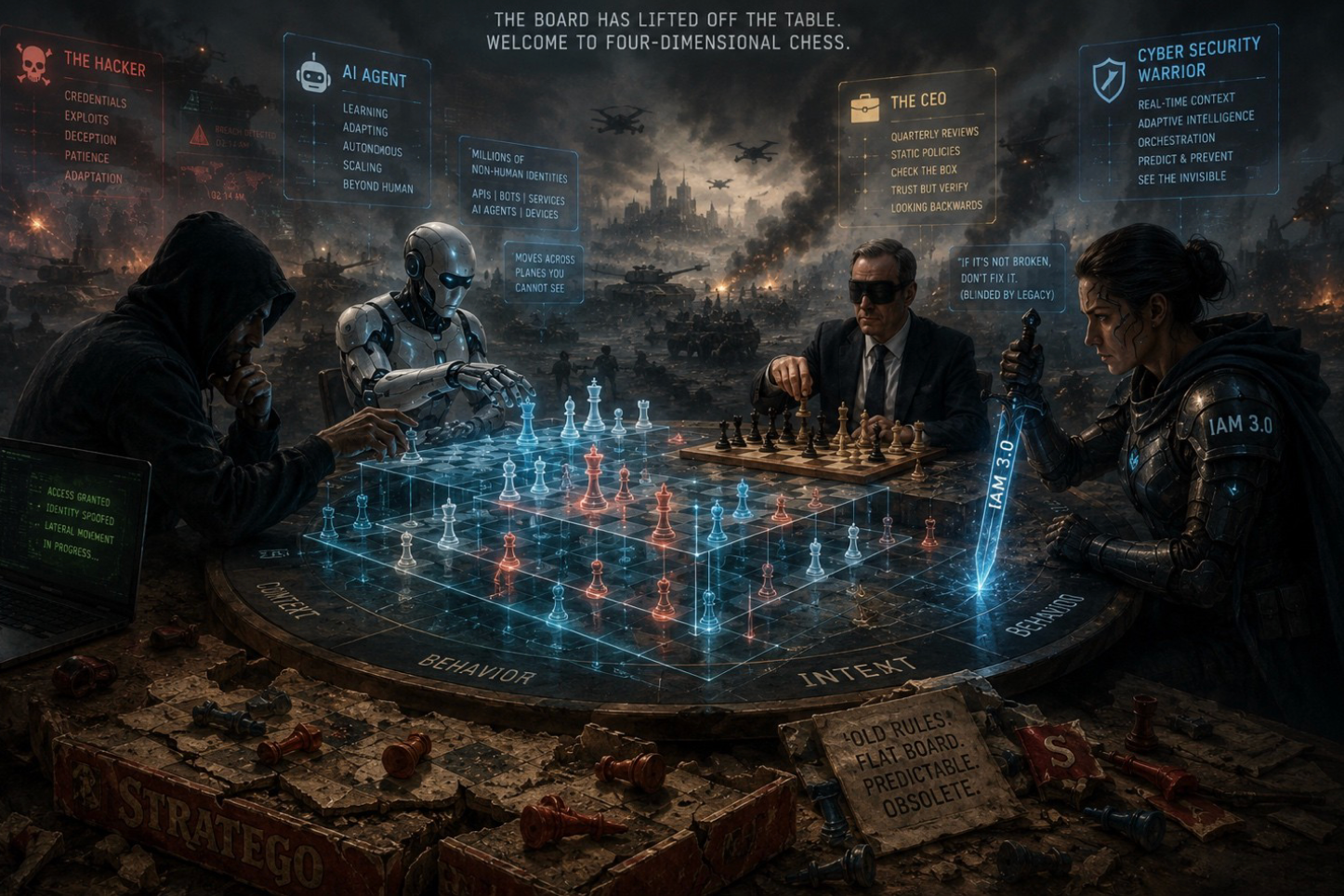
Today, we can no longer play cybersecurity Stratego®. Frankly, we can no longer play traditional chess.
What we are facing now is something far more dangerous: multidimensional chess played across systems, timelines, identities, APIs, cloud services, AI agents, and machine-to-machine relationships moving at speeds human beings cannot manually process. The modern identity battlefield no longer exists in two dimensions. It folds. It shifts. It expands. It mutates in real time. And in this new game of multidimensional chess, identity is no longer pieces on the board. Identity is the board. That distinction changes everything.
In the old world, Identity and Access Management was treated like plumbing. Necessary. Uncelebrated. Static. The job was simple: authenticate the user, authorize access, write a log entry, and move on. IAM systems were built around predictable structures because businesses themselves were predictable structures. But attackers evolved faster than the controls designed to stop them. They’ve stopped “breaking in” and started logging in.
Credentials replaced crowbars. Sessions replaced exploits. Trust became the weapon. Then came the real earthquake: non-human identities. APIs. Service accounts. Containers. Autonomous AI agents. Bots making decisions. Machine-to-machine trust relationships operating at planetary scale. Millions upon millions of identities moving continuously through environments that were never architected to understand them.
Every API token becomes a chess piece moving in multiple dimensions at once. Every AI agent becomes a potential strategist. Every forgotten service account becomes a hidden tunnel under the battlefield. And unlike the old days, these identities are not waiting patiently for human instruction. They move automatically. Dynamically. Constantly.
That is why the identity attack surface has become almost impossible to defend using traditional IAM 2.0 thinking.

Static systems cannot govern dynamic behavior. A quarterly certification campaign is worthless against an AI agent capable of making ten thousand decisions in under a second. A hardcoded role model collapses when identities change context minute by minute. Yesterday’s policies cannot predict tomorrow’s behavior. The old systems are trying to fight a quantum-speed war with paperwork and spreadsheets.
It is the Maginot Line all over again. Beautiful architecture. Expensive implementation. Completely bypassed by reality.
The harsh truth is this:
Most organizations are still playing Stratego® while the adversary is playing multidimensional chess. The attacker today does not simply attack infrastructure. The attacker manipulates trust itself. They become legitimate looking users. They poison behavior models. They exploit over-permissioned APIs. They hijack machine identities. They patiently observe patterns over time. They weaponize automation. And increasingly, they use AI to do it.
An attacker no longer needs to smash through the front door when they can quietly become an approved identity inside the system itself. That changes the nature of security entirely.
A login at 2:13 AM from a trusted account. A service account accessing datasets it has never touched before. An AI agent making decisions outside its historical pattern. A synthetic identity blending perfectly into the environment. A privileged token moving laterally through cloud systems without triggering static thresholds.
Each one is a move on the board.
And the terrifying part is this: most organizations never even realize the game has started.
Why?
Because many are still looking at the battlefield as though it were flat.
This is where IAM 3.0 fundamentally changes the conversation.
Not as marketing. Not as another product category. Not as another dashboard pretending to be innovation. IAM 3.0 is a complete philosophical shift in how identity must operate in the age of AI, autonomous systems, and continuously changing trust relationships. IAM 3.0 is not about static authorization. It is about living decision systems.
It does not ask: “Was the user authenticated?”
It asks: “Does this behavior make sense right now, in this moment, within this context, given everything else happening across the environment?” That is a radically different question. And it requires a radically different architecture. This is where modern IAM 3.0 orchestration becomes the force multiplier.
Orchestration is not merely workflow automation. That is yesterday’s thinking wearing a new suit. Modern IAM 3.0 orchestration is a living control plane sitting above fragmented identity systems, continuously evaluating trust across every layer of the environment.
It becomes the connective tissue between legacy IAM platforms, cloud systems, APIs, AI agents, behavioral analytics, runtime authorization engines, and real-time threat intelligence.
Alive. Adaptive. Continuous.
Not quarterly. Not scheduled. Not static.
The orchestration layer sees movement across dimensions most organizations cannot even visualize. It evaluates device posture. Behavioral deviation. Geographic anomalies. Velocity shifts. Risk scoring. Session context. Machine trust relationships. Runtime privilege escalation. AI decision patterns. And it acts in motion. Not after the breach. Not after the audit. Not after the board meeting. In motion. That is the difference between reacting to the game and actually playing it.
The organizations that survive the next decade will not necessarily have the biggest security budgets. They will have the most adaptive identity architectures. The fastest decision systems. The clearest visibility into machine behavior. The ability to dynamically orchestrate trust as conditions change. Because the future of cybersecurity is not perimeter security. The future is identity orchestration operating at machine speed.
And somewhere in all of this sits the most dangerous figure at the table: the executive maybe playing Stratego®, maybe playing traditional chess while everyone else in the game has moved into multidimensional warfare.
The CEO wearing sunglasses. The board demanding quarterly reports while the battlefield shifts hourly. The leadership team still asking whether modernization is “worth the investment” while autonomous AI agents quietly multiply inside the environment.
That may be the most dangerous threat of all: not ignorance… but delayed understanding.

History has never been kind to organizations that prepared for the last war instead of the next one. The old identity market was built around administration. The new identity battlefield is built around survival. And survival requires movement. It requires orchestration. It requires contextual intelligence. It requires visibility into what was once invisible. It requires systems capable of learning, adapting, and responding continuously. Most importantly, it requires accepting a difficult truth: The game board is never going to be one dimensional and flat again. The attack surface is morphing as you read this article.
There is no returning to the comfortable simplicity of Stratego®. Not as simplistic as traditional chess. No rebuilding the old perimeter. No static role model capable of governing an AI-driven future.
The game has changed permanently.
The only real question left is whether organizations will evolve fast enough to survive it. Because right now, in the quiet corners of nearly every enterprise environment on earth, the next ten moves are already being made.
The thought leaders who understand the IAM 3.0 stakes can help you make that transition today before the minefields are established in your infrastructure.