

Turning Customer Identity Into a Competitive Advantage
Contents
How one global enterprise overcame fragmented identity systems, organizational politics, and technical complexity to unlock the business value of knowing its customers.
The Real Value of Identity Isn't Authentication
For most organizations, identity and access management is viewed primarily as a security function. Its purpose is to authenticate users, control access to applications, enforce security policies, and ensure that the right people have access to the right resources. These are all important responsibilities, but they represent only part of what identity can contribute to an enterprise. When approached strategically, identity can become something considerably more valuable: a foundation for understanding customers, strengthening relationships, improving their experience, and identifying opportunities for business growth.
Identity Fusion was engaged by a global provider of specialized information, software, and professional services that recognized this opportunity. The organization served millions of customers across industries including legal, tax, accounting, and compliance. Its products were widely used by professionals throughout their careers, often beginning while those individuals were still attending university. The company understood that these long-standing relationships represented an enormous business opportunity, but its existing identity infrastructure made it nearly impossible to recognize and understand those relationships consistently.
Consider the journey of a law student who begins using the company's research applications while attending university. After graduation, that individual joins a law firm and gains access to additional products through their employer. Several years later, they move to another firm, potentially with different subscriptions and applications. Over the course of a career, that same individual might change employers several times, establish new professional relationships, and adopt additional products as their responsibilities evolve.
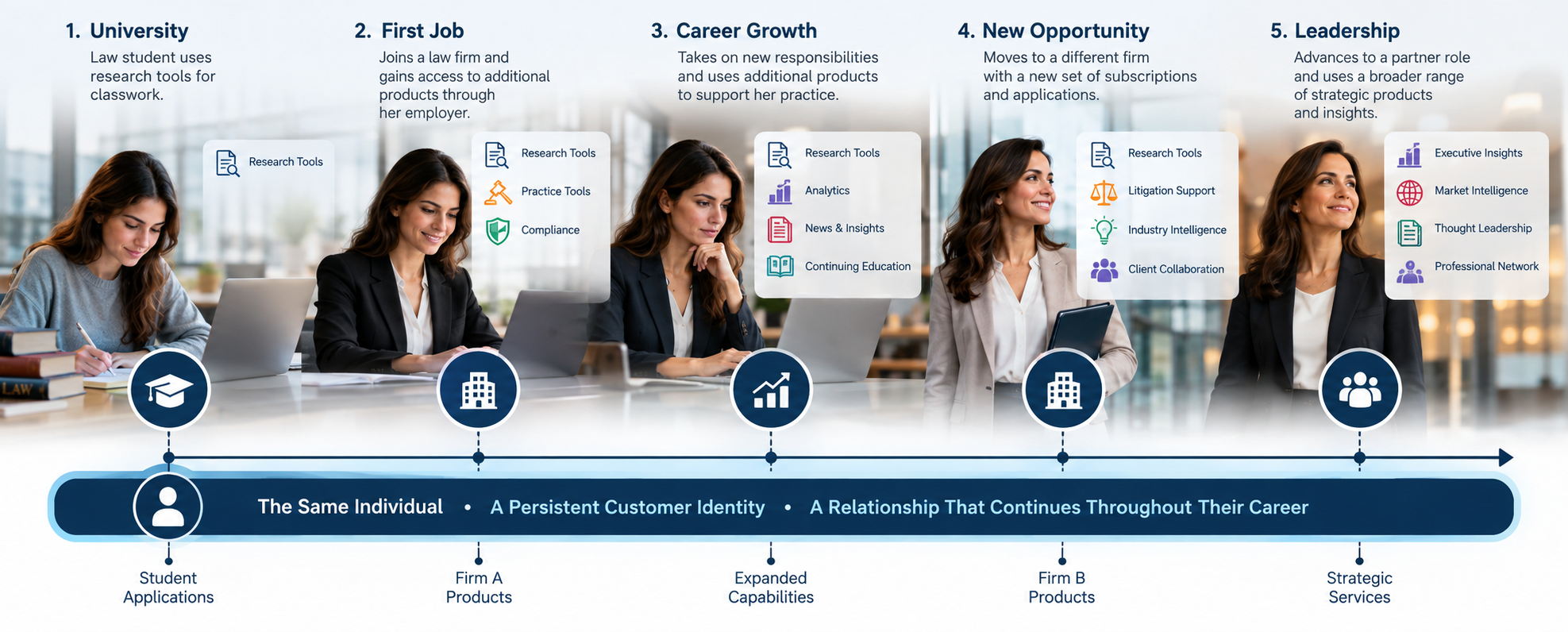
From the customer's perspective, this is a perfectly normal professional journey. From the perspective of a fragmented identity environment, however, that individual could appear to be several completely different customers. Each new account, employer, or application might introduce another identity record with little or no connection to the others. The organization could recognize the accounts, but it could not reliably recognize the person behind them.
The company's vision was to change that by establishing what it described as a cradle-to-grave relationship with its customers. The objective was to maintain a consistent identity for an individual throughout their professional life, regardless of where they worked, which applications they used, or how their relationship with the company evolved. Their employer, subscriptions, and access privileges might change, but their underlying identity would remain consistent.
That vision had implications extending far beyond simplifying authentication. If the enterprise could recognize customers consistently across products, it could begin understanding how those customers interacted with its services throughout their careers. Behavioral analytics could identify patterns, reveal relationships between products, and create opportunities to recommend additional services based on the experiences of similar customers.
Imagine being able to tell a customer, "Did you know that 90% of professionals who use Application X also find Application Y valuable?" That type of recommendation could introduce customers to services they might otherwise never discover, while creating meaningful opportunities for cross-selling and strengthening the overall customer relationship.
The challenge was that none of this was realistically achievable without a common understanding of customer identity.
Forty Identity Systems Standing in the Way
Like many large enterprises, the organization had grown through a combination of acquisitions, organic expansion, and independent business unit initiatives. Over time, individual business units developed their own identity solutions to support their respective applications and customers. Each solution generally met the requirements of the business unit that implemented it, but there was little consistency across the enterprise.
By the time the organization began addressing the problem, it had accumulated more than 40 different customer identity solutions. As the environment was examined more closely, the number of applications depending on those systems was ultimately determined to be approximately 3,000. What had originally been implemented as independent solutions to individual business problems had collectively become a substantial obstacle to the company's broader business strategy.
Customers maintained multiple accounts and credentials, application teams repeatedly developed similar identity capabilities, and security policies had to be managed across numerous independent environments. Integrating products across business units was difficult, and introducing new authentication capabilities required coordinating changes across systems that had often been designed and operated independently.
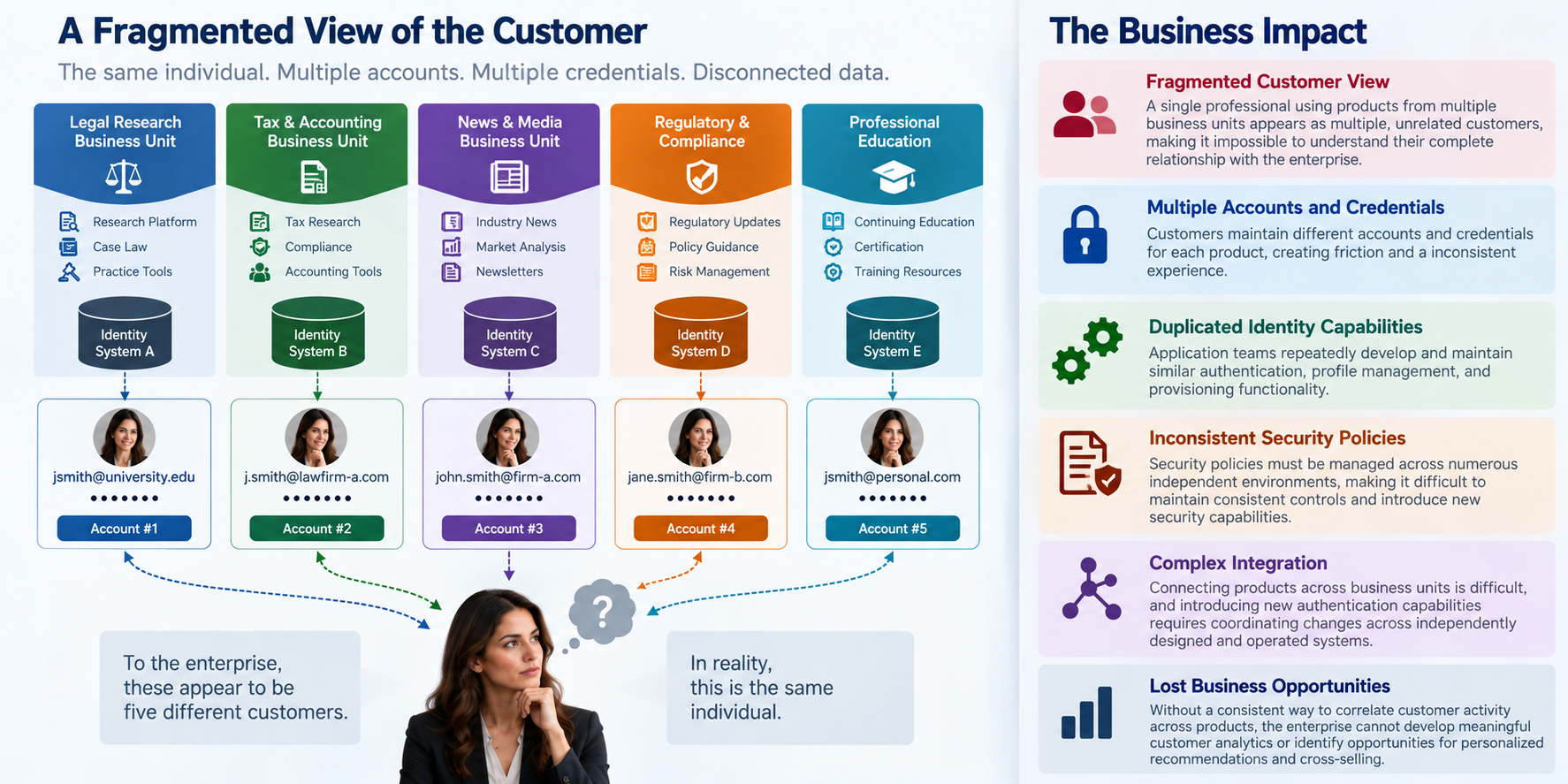
More importantly, the fragmented environment prevented the organization from developing a complete understanding of its customers. A professional using products from three different business units might appear as three unrelated individuals, making it difficult to understand their overall relationship with the enterprise. Without a consistent way to correlate those identities, the customer analytics and personalized recommendations envisioned by the business would remain out of reach.
Federation technologies such as SAML and OAuth could help applications exchange authentication information, but federation alone would not solve the underlying problem. Connecting dozens of independent identity systems might simplify certain authentication experiences, but it would not necessarily establish a common customer identity or reconcile the fragmented profile information distributed throughout the enterprise.
The organization needed more than a single sign-on. It needed an enterprise identity strategy capable of supporting its business objectives.
Building the Foundation for Business Value
Identity Fusion was engaged as the sole systems integrator to help design and implement a centralized Identity Management as a Service platform. The objective was to establish a common set of identity capabilities that applications throughout the enterprise could consume, rather than requiring every business unit to develop and maintain its own authentication, provisioning, and profile management functionality.
Built on the Ping Identity platform, the solution incorporated PingAM for authentication and federation, PingDS for identity data management, and PingIDM for identity orchestration and synchronization. A standardized API layer exposed reusable identity services, allowing applications to integrate with the new platform without having to understand the complexity of the underlying infrastructure. This service-oriented architecture provided a foundation for common authentication, authorization, profile management, provisioning, account linking, and identity lifecycle capabilities.
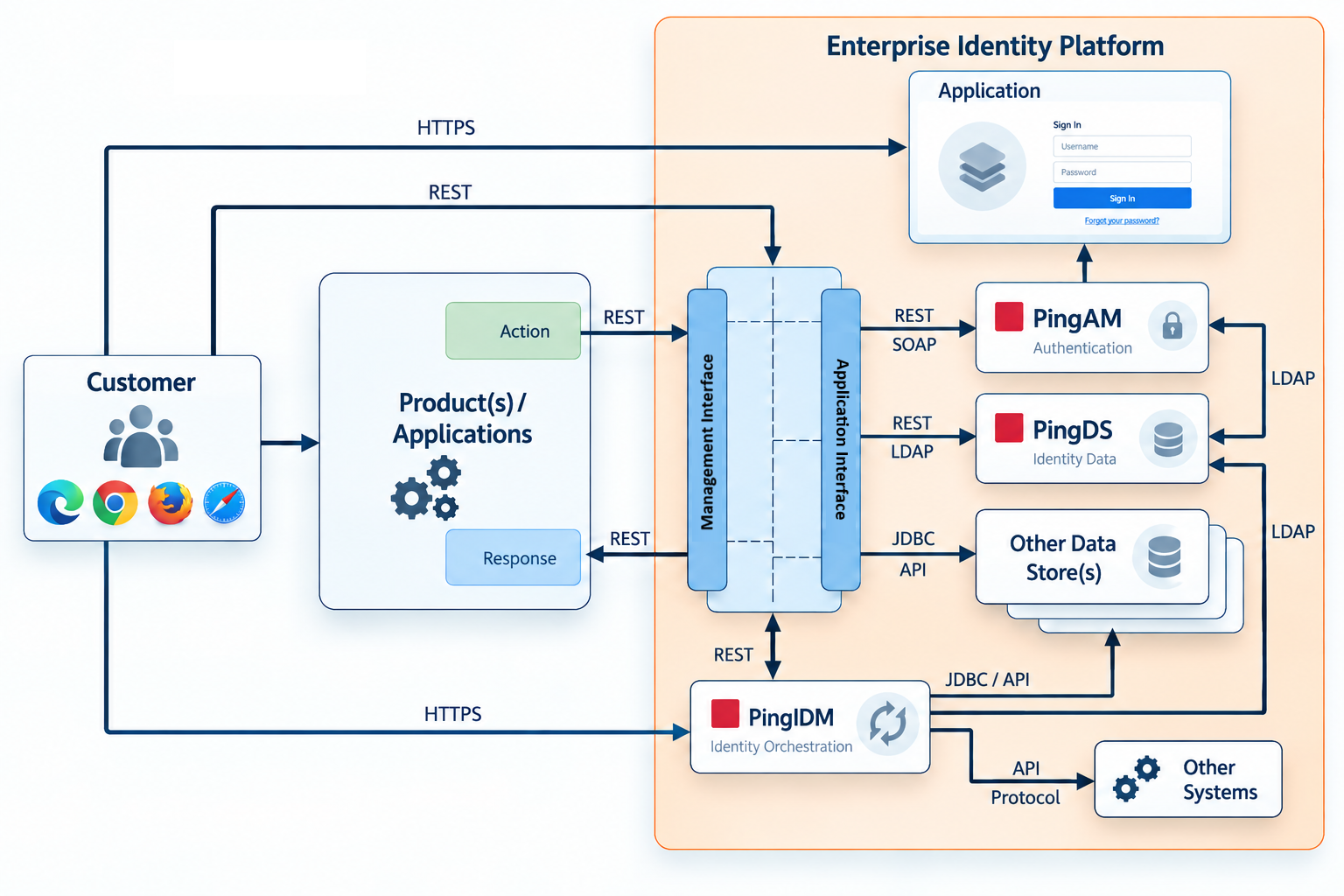
At the center of the architecture was a fundamental distinction between an individual's identity and the organizations or applications with which that individual was associated. A customer could maintain one persistent enterprise identity while having multiple employment relationships, product subscriptions, and application accounts over time. When someone changed employers, their identity would remain intact, but their access privileges would change to reflect their new organizational relationships and entitlements.
This distinction was essential to achieving the company's cradle-to-grave vision. It allowed the enterprise to recognize an individual consistently throughout their career without compromising the security boundaries between employers or the applications they used. It also established the foundation for associating customer activity across products with a common individual, making more meaningful behavioral analytics and personalized recommendations possible.
Two principles guided the design:
Recognize customers consistently from their first interaction through every subsequent product and professional relationship
Provide a common authentication experience across the enterprise.
Achieving these objectives required more than implementing new software. It required rethinking how identity was represented, managed, and shared throughout the organization
The Technology Was Complicated. The Politics Were No Easier.
Anyone who has participated in a large enterprise transformation knows that designing the technology is only part of the challenge. The other part involves convincing people who have spent years building and operating their own systems that adopting a common approach is actually a good idea. In an organization with more than 40 identity solutions distributed across multiple business units, that was no small undertaking.
When Identity Fusion became involved, the organization had an initiative champion who understood the problem and had a vision for solving it. What it did not have was an established team capable of designing, implementing, operating, and supporting an enterprise identity platform of this magnitude. Common architectural principles, integration standards, development practices, deployment procedures, and operational support processes still needed to be established.
Our role therefore extended well beyond implementing the Ping Identity technology. Working alongside the initiative's champion, we helped establish the architectural principles, design patterns, development processes, deployment procedures, and operational practices necessary to support the platform throughout its lifecycle. We also helped recruit, build, and train the internal organization that would eventually assume responsibility for the solution. By the conclusion of the engagement, that team had grown to approximately 40 professionals distributed across multiple states and countries.
The organizational challenges required just as much attention. Business units that had historically controlled their own identity environments needed to agree on common standards, shared services, and an enterprise architecture that would change how their applications operated. These discussions involved questions of ownership, responsibility, priorities, and control, all of which can become particularly sensitive when an organization proposes replacing capabilities that individual teams have spent years developing.
The key was demonstrating that centralized identity services were not intended to prevent business units from meeting their unique requirements. Instead, they would eliminate duplicated effort, simplify integration, and allow application teams to concentrate on capabilities that differentiated their products. Establishing that understanding required collaboration, persistence, and a willingness to accommodate legitimate business requirements without compromising the architectural principles necessary for the overall initiative to succeed.
The experience reinforced an important lesson: an enterprise identity strategy cannot succeed through technical architecture alone. It also requires organizational alignment, executive sponsorship, and a shared understanding of the business value the transformation is intended to deliver.
Getting There Without Disrupting the Business
With approximately 3,000 applications relying on more than 40 identity solutions, replacing the existing infrastructure in a single migration was neither practical nor desirable. Different business units had different technical requirements, application dependencies, and levels of readiness. The architecture therefore needed to support a gradual transition in which existing identity systems could coexist with the new platform while applications progressively adopted centralized services.
Some applications could migrate directly to the new environment, while others required federation, synchronization, or provisioning capabilities to maintain continuity during the transition. A common identity repository and persistent enterprise identifier allowed customer relationships to be maintained across these environments, while account linking and consolidation capabilities helped associate existing accounts with the appropriate individuals. The architecture also supported customer participation in account consolidation to reduce the risk of incorrectly combining unrelated identities.
Over the course of more than two years, Identity Fusion worked with the organization to implement the platform, integrate applications, establish operational processes, and progressively migrate customer identities. Ultimately, more than 5.5 million customer identities were migrated without downtime or customer disruption, demonstrating that even a transformation of this magnitude could be accomplished without interrupting the services customers depended upon.
We also had an unexpected opportunity to observe the customer experience firsthand. Identity Fusion's own accounting firm happened to use several of the organization's products. Following the transition, the firm reported that it had experienced no disruption and appreciated having a unified profile across the applications it used. For an initiative involving millions of identities and thousands of applications, that feedback was particularly satisfying because it demonstrated that the underlying technical complexity did not have to become part of the customer's experience.
The migration was a significant technical accomplishment, but it was never the ultimate objective. It was a necessary step toward establishing an identity foundation capable of supporting the company's broader business strategy.
The Holy Grail: Turning Identity Into Business Value
The most important outcome of this engagement was not simply the consolidation of identity infrastructure. It was the establishment of an enterprise identity foundation designed to support a fundamentally different relationship with customers. Instead of viewing customers as disconnected accounts scattered across applications and business units, the organization could begin treating identity as a persistent relationship that continues throughout an individual's professional life.
That foundation created opportunities extending well beyond authentication and access control. With a consistent understanding of customer identity, the enterprise could support a more integrated experience across products, develop a clearer picture of customer relationships, and pursue analytics capable of identifying usage patterns and opportunities for relevant product recommendations. The same capabilities that simplified authentication and identity management could also support customer engagement, product discovery, and business growth.
It is important to distinguish between establishing this foundation and realizing every potential business benefit. The architecture enabled the organization to pursue more sophisticated customer analytics and cross-selling strategies, but the implementation's success should not be measured by revenue outcomes that have not been independently established. What the project demonstrated was that identity could be designed to support those objectives rather than remain confined to the traditional responsibilities of authentication and access control.
Looking back, this engagement reinforced something we continue to emphasize at Identity Fusion. Organizations frequently approach identity modernization because they need to improve security, replace aging technology, simplify authentication, or reduce operational complexity. Those are legitimate reasons to invest in IAM, but they should not necessarily define the limits of the initiative. When identity is approached as an enterprise capability rather than a collection of technical services, it can become a foundation for improving how an organization understands, serves, and retains its customers.
Getting there requires navigating technical complexity, organizational politics, and years of independently developed systems. It requires a clear business vision, an architecture capable of supporting that vision, and the people and processes necessary to sustain it. The technology matters, but its real value comes from what the business can accomplish once those barriers have been removed.
The ultimate measure of an identity strategy isn't how effectively it manages accounts. It's how effectively it enables the business.
That is Identity in Action.
Identity Fusion helps organizations transform customer identity from a technical necessity into a strategic business asset. From consolidating fragmented identity systems to establishing unified customer profiles and enabling identity-driven analytics, we help enterprises overcome the technical and organizational challenges that stand between identity management and business value. If your identity infrastructure is limiting your ability to understand customers, deliver integrated experiences, or identify new revenue opportunities, let's talk about how a strategic approach to identity can help turn those challenges into a competitive advantage.
Read more real-world use cases on the Identity Fusion blog: