

The AI Arms Race; You Can’t Defend the Kingdom with a Swim Noodle
Contents
The Point-Solution Trap
For two decades, cybersecurity has followed the same script: A new threat emerges. A new product is bought. Firewalls for attack vectors. Authentication layers for compromised credentials. PAM for privileged accounts. IGA for governance. Analytics, ITDR, UEBA, XDR, each quarter brings a new acronym, a new promise, a new line item in the budget.
Now, artificial intelligence has entered the arena. And the industry’s response? Another tool.
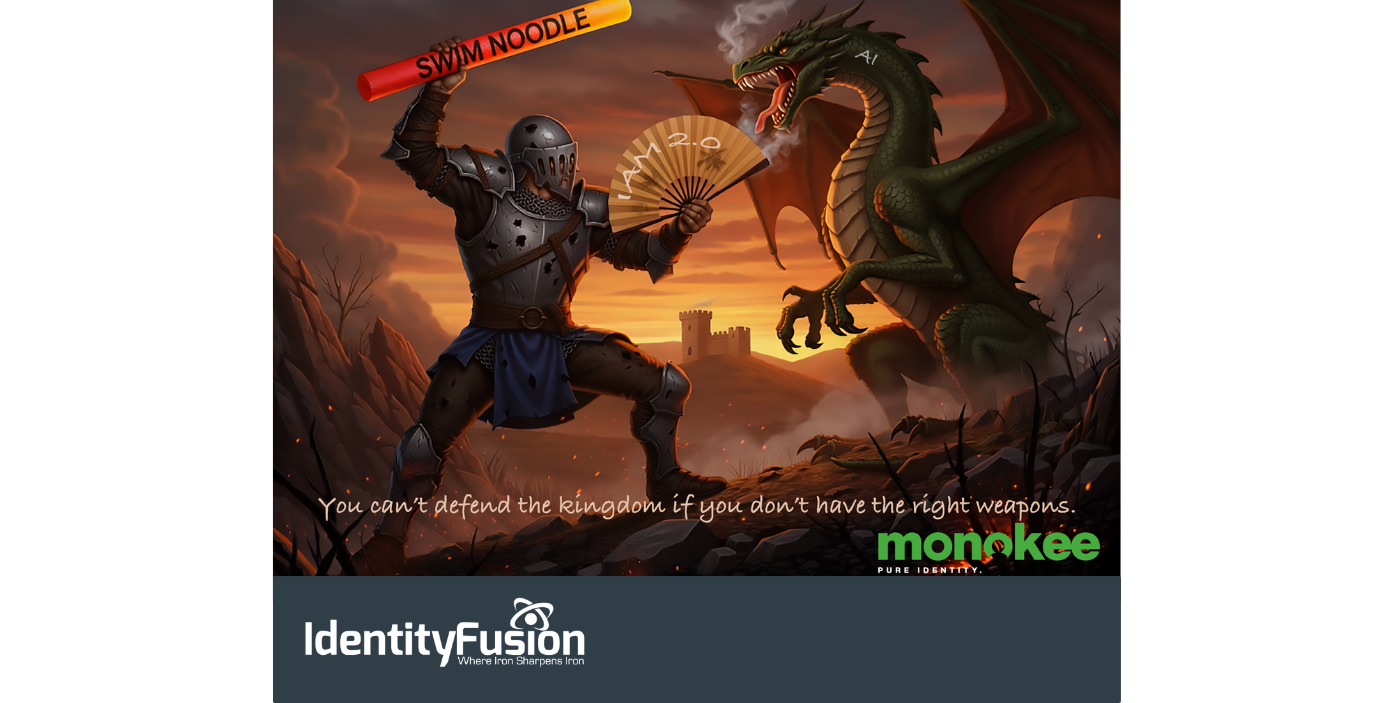
That approach isn’t just inadequate. It’s like showing up to a dragon fight armed with a swim noodle.
AI attackers don’t care about your stack. They don’t respect the neat categories of IAM, PAM, IGA, or endpoint security. They don’t pause at the borders between cloud, network, or identity. They move through all of them. They probe identities, devices, APIs, service accounts, and increasingly autonomous agents. They adapt in seconds. They exploit not just weaknesses in individual systems, but the seams between systems that were never designed to work together in real time.
That’s the fatal flaw of the point-solution model: A collection of excellent tools does not make an intelligent system. An orchestra full of virtuosos still produces noise without a conductor.
In modern identity security, that conductor is IAM 3.0 Orchestration.
The Illusion of AI Point Solutions
Today, every cybersecurity product claims to be “AI-powered.” Firewalls. Authentication. Governance. Threat detection. Even password reset buttons. The marketing has changed. The architecture has not.
Point solutions see the world through a narrow lens. Authentication evaluates authentication. PAM evaluates privileged access. IGA evaluates governance. Each may perform its function perfectly, and still miss the attack unfolding across the environment.
Consider this scenario: A compromised identity authenticates from a trusted device using valid credentials. The user invokes an AI agent, which calls an API via a service account, accesses sensitive data through an approved app, escalates privileges through a misconfiguration, and begins exfiltrating data via an authorized cloud service.
Every control reports: All clear.
Authentication: successful.
Device: trusted.
Service account: valid.
API request: authorized.
Application access: approved.
Cloud service: permitted.
And yet, the organization is breached.
The failure isn’t inside any single technology. It’s in the space between them. That’s where orchestration becomes non-negotiable.
Identity is the New Control Plane
The concept of Identity Fabric is seven years old. It helped frame the traditional. Traditional IAM was built for a predictable world. A human user. A static account. A fixed role. A simple question: Who are you, and what are you allowed to access?
That world is gone.
Identity now includes employees, contractors, customers, service accounts, APIs, machines, cloud workloads, containers, robotic processes, IoT devices, software agents, and autonomous AI systems. Identities are no longer static. They move between clouds, assume roles, generate temporary credentials, and operate at machine speed. AI agents can make thousands of decisions in the time it takes a human to open a ticket.
IAM 3.0 must ask a different question:
Who are you, what are you attempting to do, from where, using what device or agent, against which resource, under what conditions, with what current level of risk, and should you still be permitted to do it now?
This isn’t an evolution, that takes too much time. It’s a revolution in the role of identity. Identity is becoming the control plane of security. And a control plane without orchestration is just another collection of disconnected controls. It is Identity Fabric without a dynamic capability.
Why Legacy IAM Can’t Keep Up with AI
Most organizations know their identity architecture needs modernization. But ripping and replacing everything isn’t practical, or responsible. So they do what they’ve always done: They connect things. A script here. An API there. Another connector. Another workflow. Another synchronization job. Another custom integration that only three people understand, and no one dares to touch.
Eventually, the architecture resembles an archaeological dig, every layer of technology still alive, but barely breathing.
That architecture may function. But it cannot respond at machine speed.
AI changes the economics of attack. Reconnaissance, credential abuse, social engineering, vulnerability analysis, all can be automated, scaled, and executed in real time. Defenders can’t counter that with overnight sync jobs, manual approvals, and analysts switching between six consoles.
The Three Fatal Weaknesses
Latency: If risk changes now but your systems communicate in ten minutes, the attacker owns those ten minutes.
Complexity: Every new point solution adds another integration, policy engine, data source, and dependency. The result? Configuration drift, blind spots, and a security posture no one fully understands.
Context: Security decisions made in isolation are dangerous. One system sees a valid credential. Another sees a trusted device. Another sees an approved app. None see the full picture.
IAM 3.0 Orchestration solves this by creating an intelligent dynamic layer above existing technologies. It doesn’t require a full rip-and-replace. It enables and requires them to work together.
Orchestration: The Nervous System of Modern Security
IAM 3.0 Orchestration doesn’t replace your existing systems. It coordinates them to meet the current threats. Authentication systems still authenticate. Governance platforms still govern. PAM still protects privileged access. Directories still manage identities. Authorization platforms still enforce policy. Threat systems still detect anomalies.
What changes is that these capabilities no longer operate as isolated islands.
The orchestration layer:
Gathers signals from across the environment.
Adds context to every decision.
Evaluates risk in real time.
Coordinates response automatically.
When conditions change, the architecture changes with them.
A device becomes suspicious?
Step up authentication.
A user behaves abnormally?
Reduce access.
A service account acts out of scope?
Suspend its privileges.
An AI agent operates beyond its mandate?
Restrict, isolate, or terminate the session.
Traditional IAM strives to manage identities using static tools. IAM 3.0 orchestrates identity in motion dynamically.
Monokee is The Orchestration Advantage, Your Dragon-Slaying Sword
Using real weapons to fight the good fight. Platforms like Monokee represent a fundamental shift. Built from the ground up to address today’s challenges. The value isn’t just another identity repository or authentication engine. While the entire IAM stack is IAM 3.0 compliant, you can still deploy only what you need today to improve your stance. The real value is the ability to layer the orchestration plane itself onto your existing stack.
Monokee can sit across your existing identity environment and coordinate services through workflows, APIs, policy, contextual data, and risk signals. It doesn’t force you to discard years of infrastructure investment. Instead, it makes those technologies work together as a unified system.
This matters because most enterprises aren’t starting from scratch. They have Active Directory, authentication, governance, PAM, and thousands of applications built over decades. Modernization doesn’t require demolition. It requires an intelligent orchestration layer that can:
Wrap and orchestrate existing systems.
Preserve what still provides value.
Replace components only when justified.
Introduce new capabilities incrementally.
This approach transforms identity modernization from a periodic, disruptive overhaul into an evolutionary architecture, one that can adapt as the threat landscape changes.
Detection Without Action Is Just Noise
Security teams already collect vast amounts of data. The industry doesn’t suffer from a shortage of dashboards. It suffers from a shortage of coordinated action.
One platform detects an anomaly. Another holds the identity data. Another manages authentication. Another governs permissions. Another controls privilege. Another monitors the network. Another raises the alert. Then a human analyst becomes the integration layer, switching screens, opening tickets, sending messages, waiting for approvals.
Meanwhile, the dragon keeps breathing fire.
That model cannot survive the transition to AI-speed attacks. Detection without orchestration is just notification. The architecture must shift from:
Detect → Alert → Investigate → Approve → Respond
to:
Detect → Understand → Orchestrate → Respond
Humans still govern the system, setting policy, determining risk tolerance, supervising automation. But humans should no longer be the middleware connecting every security technology during an active attack. That’s not control. That’s a bottleneck. The future makes Monitoring a side car service as the responses are at machine speed.
The Machine vs. Machine Cyberwar
The future of cybersecurity is clear: Machines will attack machines, while other machines attempt to defend them.
AI attackers will automate reconnaissance, impersonation, exploitation, credential abuse, privilege escalation, lateral movement, and adaptation. AI defenders will analyze context, identify anomalies, evaluate risk, predict behavior, and initiate countermeasures.
In this environment, the organization with the most AI-enabled security products won’t necessarily win. The organization that can coordinate those technologies will.
That’s the true power of orchestration. It turns individual tools into a system. And systems defeat collections of tools.
Modernization Without Demolition
For decades, cybersecurity has treated modernization as synonymous with replacement. Replace the IAM platform. Replace the authentication system. Replace the directory. Replace PAM. Replace the replacement.
Three years later, another PowerPoint deck arrives, explaining why the technology you just implemented is now legacy.
There’s a better way: Wrap and orchestrate.
Preserve what works. Replace what doesn’t. Introduce new capabilities incrementally. Move policy, intelligence, and decision-making into the orchestration layer. Modernization becomes evolution, not revolution.
And evolution matters because AI won’t wait for your next three-year transformation program. Your architecture must be capable of changing at machine speed.
Orchestration or Obsolescence
The AI arms race is already underway. Attackers use automation and AI to compress days into hours, hours into minutes, minutes into seconds. The answer cannot be another dashboard, another alert, or another point solution.
Organizations already have plenty of tools. What they lack is coordination.
IAM 3.0 Orchestration provides that coordination. It transforms identity infrastructure into a dynamic control plane, one that understands context, evaluates risk, coordinates technologies, and responds as conditions change.
The next generation of identity security won’t be defined by any single capability, authentication, IGA, PAM, authorization, ITDR, or AI threat detection. It will be defined by how effectively all of those capabilities work together.
Platforms like Monokee point the way forward. The orchestration layer becomes the connective tissue between legacy IAM, modern security controls, and the emerging world of autonomous systems.
For twenty years, we built security silos. AI has arrived at exactly the right moment to exploit the gaps between them.
The organizations that survive the next phase of cybersecurity will be those that stop thinking of security as a collection of products and start treating it as a coordinated system.
The question is no longer whether you need another security tool. You probably don’t.
The question is whether the tools (weapons) you already own can see the same threat, understand the same context, make a coordinated decision, and act as one system, before the AI dragon burns down your entire kingdom.
That is IAM 3.0 Orchestration.
And in the AI arms race, it may be the only thing standing between knowing you were attacked and actually stopping it.