

LDAP
8 articles tagged "LDAP" from the Identity Fusion blog

In Pursuit of Trust: Exceeding Expectations in Project Delivery
Discover the importance of exceeding expectations in project delivery and the impact of dedication on building trust with partners and clients.

OpenDJ and the Fine Art of Impersonation
Directory servers are often used in multi-tier applications to store user profiles, preferences, or other information useful to the application. Oftentimes the web application includes an administrative console to assist in the management of that data; allowing operations such as user creation or password reset. Multi-tier environments pose a challenge, however, as it is difficult Read more

OpenDJ Attribute Uniqueness (and the Effects on OpenAM)
In real life we tend to value those traits that make us unique from others; but in an identity management deployment uniqueness is essential to the authentication process and should not be taken for granted. Case in point, attributes in OpenDJ may share values that you may or may not want (or need) to be unique. For Read more

Understanding OpenAM and OpenDJ Account Lockout Behaviors
The OpenAM Authentication Service can be configured to lock a user’s account after a defined number of log in attempts has failed. Account Lockout is disabled by default, but when configured properly, this feature can be useful in fending off brute force attacks against OpenAM login screens. If your OpenAM environment includes an LDAP server Read more

What do OpenDJ and McDonald’s Have in Common?
The OpenDJ directory server is highly scalable and can process all sorts of requests from different types of clients over various protocols. The following diagram provides an overview of how OpenDJ processes these requests. (See The OpenDJ Architecture for a more detailed description of each component.) Note: The following information has been taken from ForgeRock’s OpenDJ Administration, Read more
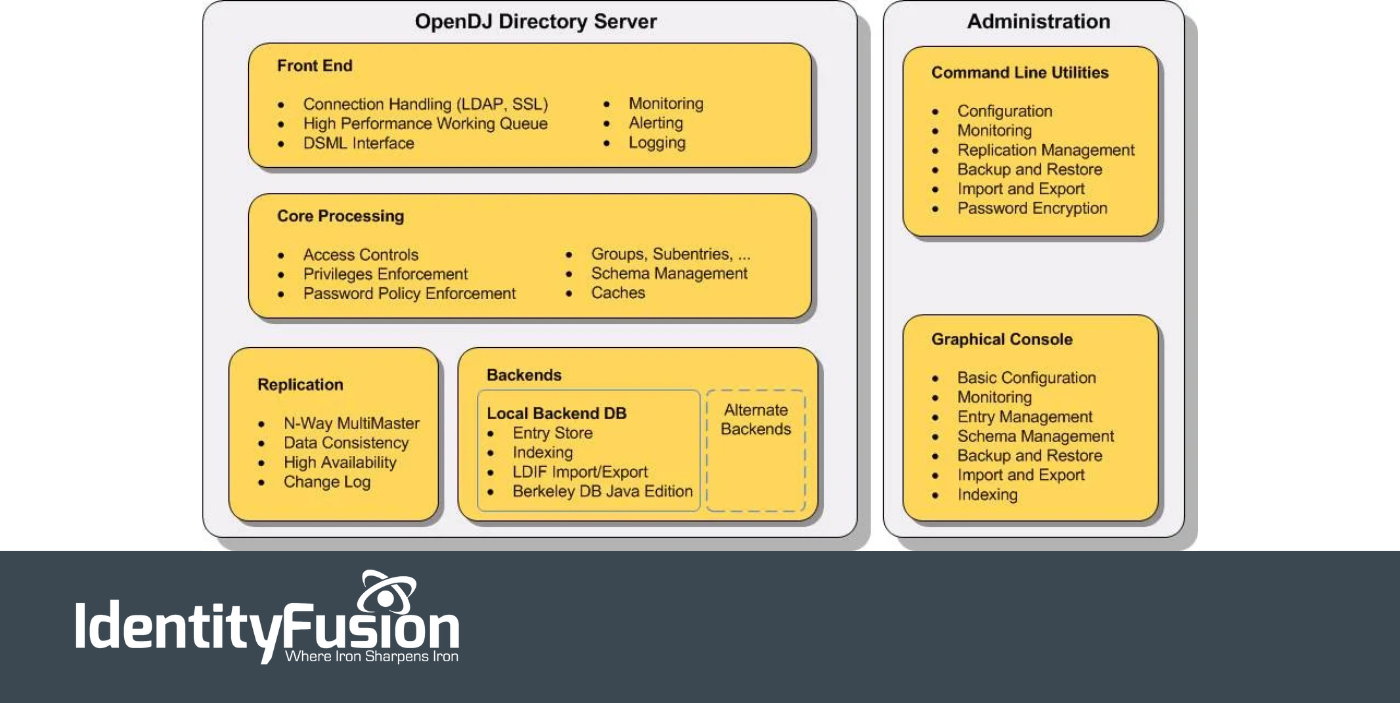
The OpenDJ Architecture
An understanding of the components that make up the OpenDJ Architecture is useful for administering, configuring, or troubleshooting the OpenDJ server. The following information has been taken from ForgeRock’s OpenDJ Administration, Maintenance and Tuning Class and has been used with the permission of ForgeRock. The OpenDJ server has been developed using a modular architecture in which most Read more

The Most Complete History of Directory Services You Will Ever Find
I started working with Directory Servers back in 1997 when Netscape was but a fledging company. Over the past 15 years a lot has changed. Companies have come and gone and code has changed hands more times than I care to remember. But one thing remains the same – that little effort started by Tim Howes, Read more

Directory Servers vs Relational Databases
An interesting question was posed on LinkedIn that asked, “If you were the architect of LinkedIn, MySpace, Facebook or other social networking sites and wanted to model the relationships amongst users and had to use LDAP, what would the schema look like?” You can find the original post and responses here. After reading the responses Read more