

If MCP Is Becoming the Nervous System of AI, Identity Must Be Its Control Plane; Strengthening Model Context Protocol Security with IAM 3.0 Enabled Orchestration
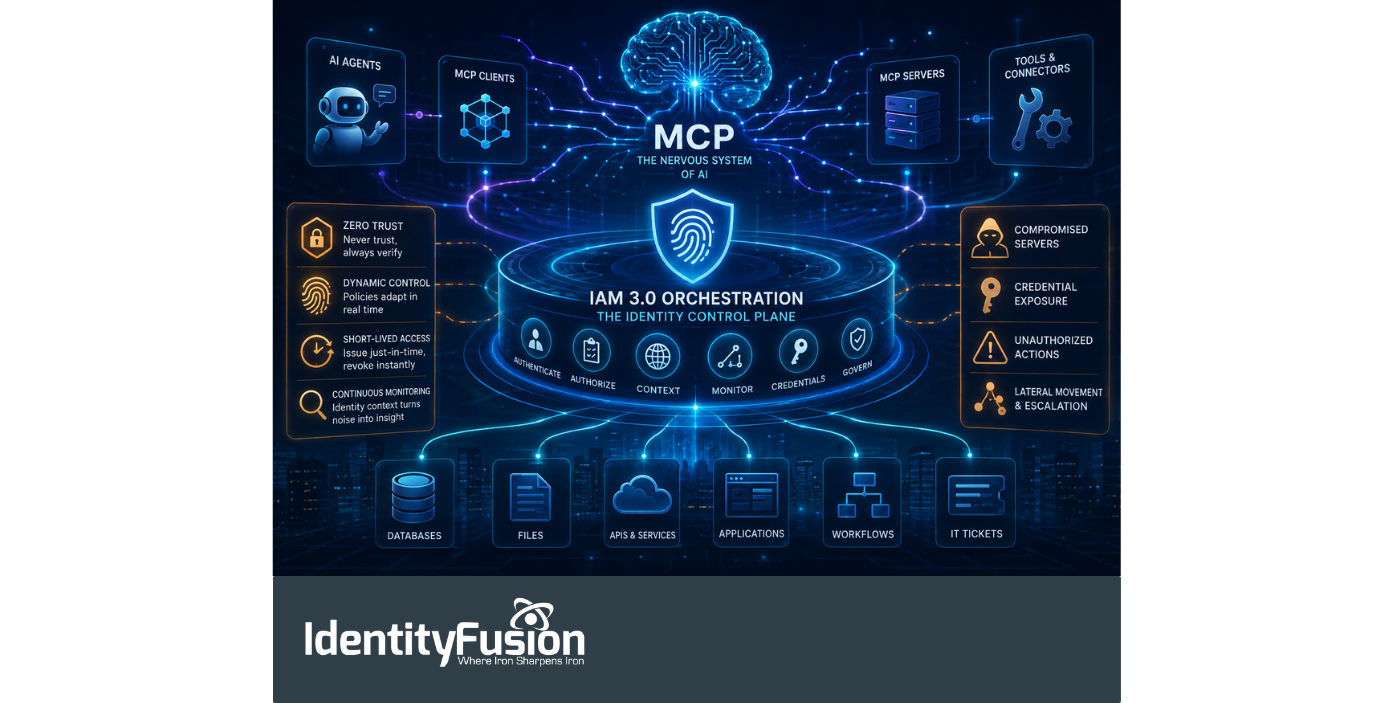
Contents
The Rise of MCP and Its Security Challenges
The Model Context Protocol (MCP) is rapidly emerging as a cornerstone of the AI ecosystem. It provides AI systems with a standardized way to interact with tools, applications, databases, APIs, files, services, and other external resources. While this connectivity may seem like mere "plumbing," it becomes critical when autonomous AI agents access the systems that power businesses.
MCP addresses a pressing need: AI becomes exponentially more valuable when it can interact with external systems. An AI agent that retrieves documents, queries databases, creates service tickets, or executes workflows is far more powerful than one confined to text generation. However, every connection MCP enables also introduces a potential entry point into the enterprise.
This is a familiar story in technology. For decades, innovation has outpaced security architecture. We connect first, automate second, scale third, and only later ask: Who is controlling all of this? MCP risks repeating this pattern unless identity is placed at its core from the outset.
Security researchers and vendors, including Palo Alto Networks and Red Hat, have already flagged concerns about MCP implementations. These include:
Trust issues between MCP clients and servers
Authentication weaknesses
Credential exposure
Inadequate isolation
The risk of compromised MCP servers accessing sensitive enterprise resources
These are not hypothetical risks, they are the predictable consequences of a protocol designed to connect intelligent systems with valuable resources.
The solution is not to slow MCP adoption but to reframe MCP security as an identity problem.
The Core Issue: Trust, Not MCP Itself
MCP is not inherently insecure. Neither were the cloud, APIs, or mobile applications. The danger arises when connectivity expands faster than an organization’s ability to determine:
Who, or what, is connecting?
What are they authorized to do?
What context surrounds the request?
Should that authorization still exist five seconds later?
Traditional Identity and Access Management (IAM) was designed for predictable relationships:
A human authenticates and receives role-based access.
Applications use service accounts.
Systems exchange credentials.
Governance processes periodically review permissions.
AI agents shatter this predictability.
An MCP client may act on behalf of a human, an application, another agent, or a chain of agents. An MCP server may expose tools and resources with varying sensitivity levels. The same agent might be legitimate when accessing public documentation but unauthorized when attempting to retrieve customer financial records.
Identity can no longer answer just "Who are you?" It must answer:
Who are you?
Who authorized you?
What are you acting on behalf of?
What are you attempting to access?
Under what conditions?
Should you still be allowed to do this right now?
This shift is the difference between IAM as administration and IAM as a security control plane.
MCP Expands the Attack Surface
MCP’s architecture connects AI clients to servers, which expose tools that interact with enterprise systems, often containing privileged data or executing critical functions. Consider the risks:
A malicious MCP server masquerading as a legitimate service
A compromised server or stolen MCP client credentials
An agent manipulated into invoking unauthorized tools
The problem escalates quickly. Poor isolation between MCP workloads can allow attackers to move beyond the original server. Long-lived credentials can turn a single compromise into persistent access. Weak authentication can permit unauthorized clients to invoke legitimate MCP services. Excessive permissions can turn a minor application compromise into enterprise-wide exposure.
What’s new is the speed at which AI can exploit these vulnerabilities.
A compromised human account might take minutes or hours to navigate systems. An autonomous agent can discover resources, invoke tools, enumerate permissions, execute workflows, and propagate actions in seconds.
The attack surface isn’t just larger, it’s faster.
IAM 3.0 Orchestration: The Solution
Traditional IAM controls, least privilege, MFA, RBAC, credential rotation, remain necessary but are no longer sufficient as isolated measures. The architecture needs an intelligent orchestration layer capable of coordinating identity decisions across the MCP ecosystem.
This is the role of IAM 3.0 Orchestration. Instead of embedding identity logic independently into every MCP client, server, AI framework, and backend application, IAM 3.0 centralizes policy and orchestration across these relationships.
Key Capabilities of IAM 3.0 Orchestration:
Dynamic Control: Identity, authentication, authorization, context, governance, credentials, telemetry, and workflow decisions converge in one layer, and can change dynamically.
Revoke access if a credential is compromised.
Reduce permissions if an agent behaves abnormally.
Require additional authorization for unusual access attempts.
Redirect connectors and workflows without rebuilding the identity architecture.
Runtime Adaptability: The ability to change identity behavior at runtime may become a defining requirement of AI-era cybersecurity.
Authentication: Machines Need Identity Too
Every participant in an MCP transaction, humans, AI agents, MCP clients, servers, applications, workloads, APIs, service accounts, containers, and other non-human identities, must have a verifiable identity.
Foundations for Authentication and Authorization:
OAuth 2.0 and OpenID Connect: Provide critical authentication and authorization frameworks.
Certificate-Based Authentication: Strengthens machine-to-machine relationships.
Workload Identities: Replace shared service credentials.
MFA: Remains mandatory for human involvement in sensitive operations.
However, organizations must avoid creating isolated authentication silos. IAM 3.0 Orchestration centralizes authentication requirements, ensuring consistent application across MCP workflows.
Authentication must be contextual, not static.
An AI agent retrieving a public knowledge-base article may require minimal assurance.
The same agent initiating a financial transaction should require significantly more.
Authorization: The Real Battlefield
Authentication verifies identity. Authorization determines what damage it can cause.
For MCP environments, authorization must become dramatically more granular. It’s no longer enough to say an agent can access an MCP server. Organizations must define:
Which tools the agent can invoke
Which resources those tools may access
What operations they may perform
What data they may retrieve
Under what circumstances these permissions apply
Beyond RBAC: Contextual and Attribute-Based Controls
Traditional Role-Based Access Control (RBAC) provides a foundation, but AI environments require contextual and attribute-based controls. For example:
An AI assistant authorized to retrieve customer information for a service representative might depend on:
The representative’s role
The customer’s account
The request’s geography
The device being used
The sensitivity of the requested information
The agent performing the operation
Behavioral indicators observed during the session
This goes far beyond simple role membership. IAM 3.0 Orchestration allows these policies to be evaluated centrally while integrating with existing authorization technologies.
Credentials: Disposable, Not Permanent
One of the most dangerous assumptions in enterprise security is that credentials are permanent assets. They should be treated as temporary instruments.
Long-lived service accounts and embedded API keys have created security problems for years. MCP could exacerbate this issue if every new server, agent, connector, and tool receives another permanent credential.
The Better Model: Short-Lived Access
Credentials should be issued when required, scoped to the precise task, and revoked when the task ends.
Secrets should remain in hardened vaults, not in application code or configuration files.
Rotation should be automated.
Credentials should be bound to workloads wherever possible.
IAM 3.0 Orchestration can coordinate this lifecycle.
Example workflow:
An MCP workflow requests access to a database.
The orchestration layer validates the agent, the user behind the request, the purpose, and applicable policies.
A temporary credential is created.
The workflow executes.
The credential expires.
Access exists for minutes, not months. This dramatically reduces the value of stolen credentials.
Isolation: Identity Must Participate
Sandboxing remains a critical defense. MCP servers should not automatically inherit broad network visibility just because they need access to one enterprise resource. Tools like containerization, Kubernetes controls, virtualization, private networks, VPCs, segmentation, and workload isolation can reduce the blast radius of a compromised MCP component.
But network isolation alone is not enough. Identity must participate in isolation decisions.
Example:
An MCP server normally communicates with three services but suddenly attempts connections to 27.
The network sees traffic.
Identity sees behavior.
IAM 3.0 Orchestration can combine identity context with runtime telemetry to determine whether the interaction remains legitimate and dynamically restrict access when necessary. This transforms segmentation from a static architecture into an adaptive security control.
Monitoring: Identity Context Turns Noise into Insight
Most enterprises already have vast amounts of telemetry. What they often lack is context.
A SIEM can tell you an API was called.
An identity-aware orchestration layer can tell you:
An autonomous agent invoked the API on behalf of a financial analyst.
It used a temporary credential issued 30 seconds earlier.
The request came through an MCP server that had never previously accessed that dataset.
These are vastly different levels of visibility. IAM 3.0 can feed identity context into SIEM, ITDR, SOC, UEBA, and security analytics platforms while consuming risk signals from those systems.
This creates a closed-loop identity security system:
The identity layer grants access.
Security telemetry observes behavior.
Risk changes.
Identity adapts.
Access changes again.
This cycle can occur continuously, which is precisely what AI environments require.
A Simple MCP Example: IAM 3.0 in Action
Imagine an organization using MCP to allow an AI system to assist data scientists with model training. The AI agent requires access to several data repositories.
Traditional Implementation:
The MCP client authenticates using a service account with access to multiple storage buckets.
The credential remains valid indefinitely.
IAM 3.0 Architecture:
The AI agent receives a unique machine identity.
The human requesting the operation is also identified.
RBAC establishes baseline permissions for the data scientist.
Attribute-based policies evaluate which datasets are appropriate for the project.
When the MCP client attempts to access a storage bucket, IAM orchestration evaluates the request.
A temporary credential is issued, restricted to one dataset and one workflow.
The workflow completes, and the credential expires.
Identity telemetry continuously monitors the agent. If it attempts to retrieve data outside the approved scope, the orchestration layer denies access or triggers additional verification.
Governance processes automatically review inactive agents, abandoned connectors, unused entitlements, and excessive permissions.
The result? Not just better security, but a smaller attack surface by design.
Zero Trust Meets Autonomous AI
The security industry has long championed the principle: Never trust, always verify.
AI will determine whether we truly meant it.
MCP servers should not automatically trust clients.
Clients should not automatically trust servers.
Agents should not receive implicit trust simply because they were deployed by the enterprise.
Applications should not assume every request through an approved MCP connection is legitimate.
Every transaction must be evaluated according to:
Identity
Authorization
Context
Behavior
Risk
This is Zero Trust applied to AI infrastructure. IAM 3.0 provides the orchestration layer capable of implementing it without requiring organizations to replace every identity system they already own.
The Control Plane Matters More Than Individual Products
The security industry has spent decades buying point solutions:
Authentication products
Governance products
PAM products
Authorization products
Secrets management products
SIEM, ITDR, API security
Now, AI security
Each solves part of the problem. But an AI agent doesn’t care how your security budget is organized, it moves across all of them.
MCP exposes this fragmentation immediately because MCP exists to connect systems. Trying to secure a connected AI ecosystem with disconnected security controls is fundamentally backward.
IAM 3.0 Orchestration reverses this architecture. The orchestration layer becomes the identity control plane, spanning existing technologies. Policies can be changed centrally, connections redirected, authentication requirements strengthened, credentials revoked, and authorization decisions updated, all without forcing developers to rewrite every MCP integration each time security requirements evolve.
This agility is critical because MCP environments will change constantly:
New agents will appear.
New servers will appear.
New tools will appear.
New vulnerabilities will appear.
The control architecture cannot be static.
Challenges and Considerations
Implementing IAM 3.0 Orchestration is not trivial. Key challenges include:
Developer Frustration: Poorly designed granular identity controls can hinder productivity.
Legacy Systems: Older systems may lack modern APIs or identity capabilities.
Performance: Runtime authorization introduces latency considerations.
High Availability: The orchestration layer must be highly available, as identity becomes critical infrastructure in the transaction path.
Scalability: Enterprises may eventually manage thousands or millions of machine identities, agents, connectors, workloads, and MCP transactions. Traditional IAM systems, designed for employee onboarding/offboarding, will struggle with this velocity.
The answer is not to weaken controls but to modernize the architecture.
IAM 3.0 must be designed for:
Runtime decisions
Automation
Abstraction
Interoperability
Orchestration
The systems beneath it can evolve over time, but the control plane must work now.
MCP Security Must Start with Identity
The industry will create dozens of products promising to secure MCP. Some will be valuable; others will fade quickly. But the fundamental architecture must remain clear:
MCP creates connections.
Connections create trust relationships.
Trust relationships require identity.
Identity must control what is allowed across those relationships.
This is why IAM must evolve beyond its traditional administrative role. IAM 3.0 Orchestration turns identity into a dynamic control plane, capable of governing humans, machines, applications, APIs, workloads, and autonomous agents across increasingly complex environments.
Key Questions for Organizations Adopting MCP
Organizations adopting MCP should ask:
Who controls the identity of every MCP client and server?
Who determines what each agent is authorized to do?
How quickly can credentials be revoked?
Can permissions change while a workflow is running?
Can the organization disable one connector without dismantling an entire application?
Can security telemetry automatically alter identity decisions?
Can you explain exactly why an AI agent was allowed to perform an action five minutes after it happened?
If answering these questions requires opening six consoles, calling three teams, and sifting through logs, the organization does not have control, it has connectivity. There is a difference.
The Next Identity Perimeter
MCP will likely become a critical connective tissue for enterprise AI. Securing it is urgent, but it also presents an opportunity: For once, the industry doesn’t have to wait until the architecture is impossible to unwind before designing security into it.
Action Steps:
Security Teams: Audit existing and planned MCP deployments for authentication, authorization, credential, machine identity, and governance gaps.
Developers: Treat every agent, server, and workload as a first-class identity. Stop treating MCP credentials as ordinary application configuration.
Executives: Recognize that AI infrastructure cannot be separated from identity strategy.
Enterprises: Begin building IAM orchestration architectures capable of dynamically controlling these environments.
The future identity perimeter will not be a firewall, a directory, or even a single identity platform. It will be the orchestration layer that understands the relationships among humans, machines, AI agents, applications, data, and infrastructure, and can determine in real time whether those relationships should be allowed to continue.
MCP may become the nervous system connecting enterprise AI. IAM 3.0 must become the control plane deciding what that nervous system is allowed to touch.