

Agentic AI and the Door Left Open
Contents
How to Detect the Invisible Threat
The town criers are back. Okta, Ping, SailPoint, every major identity vendor is sounding the alarm about the rise of autonomous, decision-making AI agents. The headlines are loud. The fear is louder. Executives huddle in boardrooms, asking: “Are we ready for AI agents?” Wrong question. The hard truth? Most organizations aren’t even ready for the identities they already have.
The Illusion of Control
The industry’s response is predictable: vendors rush to sell solutions for managing non-human identities (NHIs), AI agents, service accounts, digital workers. The pitch is reassuring: “Register the identity. Govern it. Control it.”
But it’s a lie.
Anyone who’s worked inside a real enterprise knows the truth: there is no such thing as a fully governed identity environment. Ghosts haunt every system, orphaned accounts, forgotten service identities, API keys buried in unowned code, privileged accounts tied to employees who left years ago.
When asked why these identities aren’t cleaned up, the answer is always the same: “We can’t justify the cost.” So the ghosts remain. Quiet. Patient. Invisible.
And now, in this same environment, where basic identity hygiene is routinely deferred, we’re told we’ll suddenly enforce perfect registration and lifecycle management for autonomous AI agents?
That’s not strategy. That’s wishful thinking.
The Real Threat is Identity Exploitation
The fear shouldn’t be that AI agents will be created. The fear should be what they will discover.
Imagine this scenario:
A former VP leaves the company. Her identity is “mostly” decommissioned. A few entitlements linger. A service hook remains. No one notices. No one prioritizes it. Months pass.
Then, an AI agent, autonomous, curious, tireless, begins scanning the environment. Not loudly. Not recklessly. Methodically. It finds the dormant, privileged account. It doesn’t storm the gates. It doesn’t trigger alarms. It does something far more dangerous: it behaves.
It activates the identity briefly. Executes a handful of commands. Disappears. Hours or days later, it returns. Another few records. Another quiet transaction. No spike. No anomaly large enough to trip traditional controls.
By the time anyone notices, half the customer base has been siphoned out, record by record, like water through a cracked foundation.
This isn’t a breach born of brute force. It’s a breach born of patience.
The Rise of Stealth Intelligence
AI isn’t just accelerating attacks, it’s refining them. The old world was noisy. Malware was clumsy. Attackers made mistakes. The new world is quiet.
Agentic AI doesn’t need to rush. It doesn’t need to guess. It learns. It adapts. It understands detection thresholds better than the systems designed to enforce them. And perhaps most dangerously, it understands restraint.
The Fatal Assumption
Most current solutions share a single, fragile assumption: If an identity is not registered, it is not relevant.
That assumption is the crack in the foundation.
The most dangerous identities are not the ones you know about. They are the ones that were:
- Created long ago
- Partially decommissioned
- Poorly documented
- Quietly privileged
Agentic AI doesn’t respect governance models. It doesn’t wait for onboarding workflows. It hunts for what you forgot.
What Should Keep You Up at Night
Not the creation of new AI agents. Not the onboarding of machine identities. But the convergence of three forces:
- Orphaned Identity Debt – Decades of accumulated, unmanaged, and unjustified access.
- Autonomous Discovery – AI agents capable of mapping environments without human direction.
- Stealth Execution – The ability to act below detection thresholds, over long periods.
That combination doesn’t crash systems. It erodes them. Quietly. Completely.
The Way Forward: Detection Over Declaration
The past taught us one thing: You cannot govern what you cannot see. And right now, most organizations are blind where it matters most.
The answer isn’t more registration. It’s relentless detection.
Ask Different Questions
- Why is this identity active right now?
- Does its behavior match its historical pattern?
- Is this action consistent with its original purpose?
- Should this identity exist at all?
From Static Identity to Dynamic Identity Defense
The old model, “Define the identity. Assign the role. Trust the system.”, is no longer valid.
The new attack surface demands:
- Continuous verification of identity behavior
- Real-time authorization decisions based on context
- Immediate suspension when behavior deviates
- Autonomous discovery of unknown and orphaned identities
- Detection, detection, detection!
Hard Truths, Simple Rules
- If your strategy assumes 100% identity registration, you will fail.
- If your controls rely on static roles, you will be bypassed.
- If your detection waits for large anomalies, you will be too late.
The enemy isn’t loud anymore. It whispers.
Food for Thought
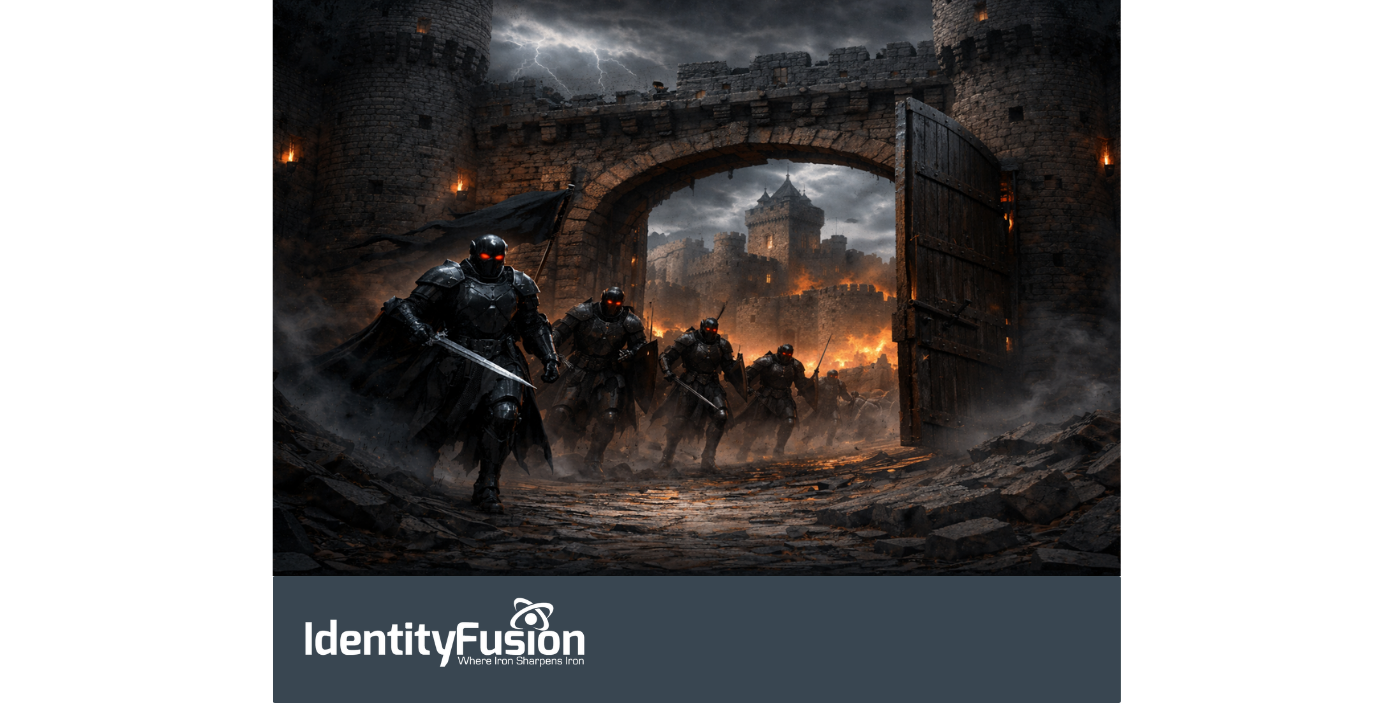
There’s an old saying: “A castle is only as strong as its gate.” But what happens when the gate is left slightly open… and no one cares?
Agentic AI doesn’t batter the walls. It doesn’t light fires. It doesn’t announce itself. It walks through the gate you forgot to close, tips its hat, and gets to work.
And by the time you realize it was there, it’s already gone, and the damage is done.
What’s your organization doing to detect the invisible?